Vetsys Pharmaceutical Vetsys Pharmaceutical

Why Are Powder Injections More Stable Than Liquids?

Time:2026-09-20 Author:Oliver
0%

In pharmaceutical development, injectable stability begins long before a vial reaches a hospital refrigerator. Scientists examine moisture, oxygen, temperature, light, and container closure integrity. These factors can slowly change a drug’s potency or appearance.

The central question is: why are powder injections more stable than ready-to-use liquids? Many powders are produced by freeze-drying, or lyophilization. This process removes water under controlled pressure while preserving sensitive molecules. A dry cake usually gives hydrolysis fewer opportunities to occur. It can also reduce chemical reactions linked with molecular movement in solution. A nurse may see a pale, intact cake inside the vial, rather than particles or discoloration. However, appearance alone cannot prove quality.

Liquid injections already contain the solvent needed for reactions. Heat exposure during transport may accelerate degradation, especially for proteins, peptides, and certain antibiotics. Powders still require careful packaging, validated storage, and correct reconstitution. A stopper that admits moisture can undermine months of development. Not always. Some dry formulations are fragile, difficult to manufacture, or unstable after mixing. Therefore, this comparison needs evidence from stability studies, assay results, particulate testing, and real-time storage data. Good practice also considers usability, because preparation errors can affect the final dose. The science is strong, but no formulation wins automatically.
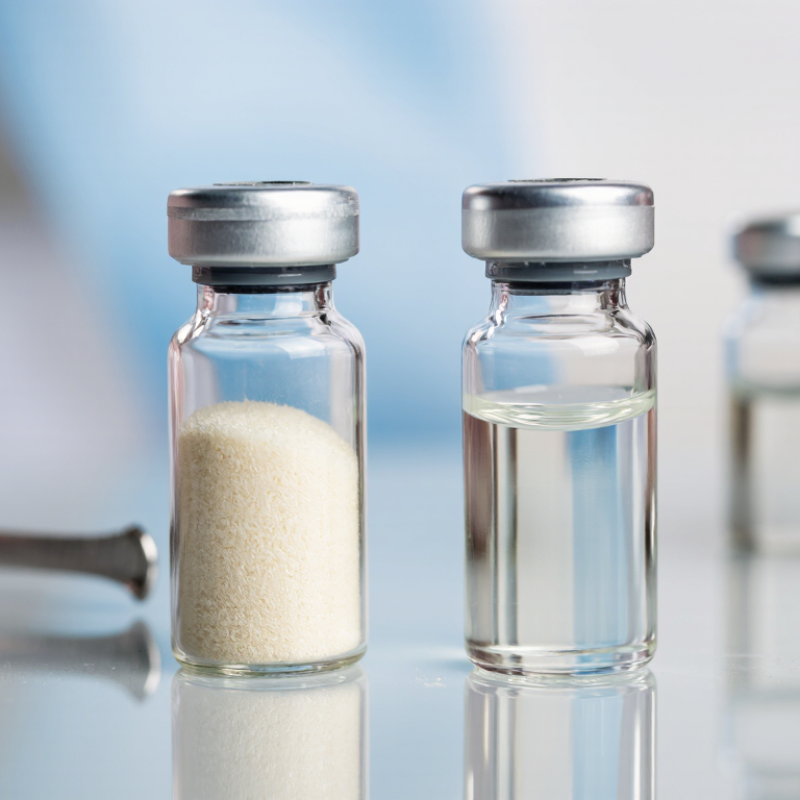
Why Are Powder Injections More Stable Than Liquids?

What Are Powder Injections and Liquid Injections?

Powder injections are sterile medicines supplied as dry powder inside a sealed vial. Before administration, a healthcare professional adds a specified sterile diluent. The powder then dissolves or disperses into an injectable solution. Many are produced through freeze-drying, also called lyophilization. This process removes water under controlled conditions. Less water often slows hydrolysis and microbial growth.

Liquid injections arrive ready for use, although some are solutions and others are suspensions. A solution looks clear because the active ingredient is fully dissolved. A suspension contains fine particles that may settle during storage. It usually needs gentle mixing before administration. The difference is practical: a powder requires reconstitution, while a liquid requires careful inspection, handling, and sometimes shaking.

Industry data shows why both formats remain important. Grand View Research estimated the global injectable drug delivery market at about USD 754.9 billion in 2023, with projected growth through 2030. Fortune Business Insights reported a lyophilized injectable market value of approximately USD 3.86 billion in 2023. These figures reflect expanding demand, not proof that powder is always superior. I would not call powder automatically safer. A poorly sealed vial can absorb moisture, and incorrect reconstitution can create dosing errors. The real advantage appears when formulation scientists control moisture, temperature, oxygen exposure, and container integrity. FDA aseptic-processing guidance also emphasizes validated sterility controls throughout manufacturing and handling. Stability is a system, not merely a powder.

How Moisture Affects the Stability of Injectable Medicines

Why Are Powder Injections More Stable Than Liquids?

How Moisture Affects the Stability of Injectable Medicines

Powder injections often remain stable because little water is available for chemical reactions. Moisture can accelerate hydrolysis, oxidation, and molecular breakdown. A liquid formulation gives these reactions a continuous environment. A dry powder slows them considerably.

However, dry does not mean invulnerable. Humidity may enter through a stopper, seal, or tiny packaging defect. The powder can then absorb water, forming clumps or changing its structure. Some medicines lose potency gradually, while others become difficult to dissolve after reconstitution. In pharmaceutical development, teams monitor water content, visual changes, potency, and reconstitution time. These measurements provide stronger evidence than appearance alone. A clear vial is not always a stable vial.

Tips: Store injectable powders within the labeled temperature range. Protect them from damp rooms, repeated opening, and damaged packaging. Check the powder before use. Look for discoloration, caking, or unusual particles after adding the approved diluent. Use only the specified diluent and follow the stated time for administration. Do not assume refrigeration always improves stability; condensation can introduce moisture when a cold vial meets warm air. This detail is easy to miss. Testing also has limits, because laboratory humidity conditions may not mirror transport or bedside handling.

Why Are Powder Injections More Stable Than Liquids? - How Moisture Affects the Stability of Injectable Medicines
Stability Dimension Powder Injection Before Reconstitution Liquid Injection During Storage Practical Implication
Physical state A dry, porous cake or particulate solid with very limited molecular mobility. An aqueous solution in which drug molecules, water, oxygen, and excipients can move and interact. Lower molecular mobility generally slows many degradation reactions in the dry state.
Water availability Water is largely removed during drying; residual moisture is controlled by the manufacturing process and container closure. Water is the continuous medium and is present throughout the product shelf life. Reducing available water can reduce hydrolysis and mobility-dependent degradation, but excessive drying can also damage some formulations.
Hydrolysis risk Usually lower before reconstitution because hydrolytic reactions require sufficient molecular water and mobility. Potentially higher because ester, amide, lactam, and other hydrolysis-sensitive groups remain in an aqueous environment. Water-sensitive medicines are often supplied as dry powders when suitable formulation and reconstitution are possible.
Moisture sensitivity Moisture uptake can cause collapse, crystallization, caking, increased mobility, or accelerated chemical degradation. Additional environmental moisture usually has less direct effect because the formulation is already aqueous, although evaporation can change concentration. Dry powders require moisture-barrier containers, suitable stoppers, and controlled storage conditions.
Protein aggregation Can be minimized by appropriate lyoprotectants and controlled drying, although drying and rehydration may introduce stress. May increase over time through unfolding, surface adsorption, agitation, temperature exposure, or interaction with interfaces. Drying does not guarantee stability; formulation design must protect the molecule during both drying and reconstitution.
Oxidation potential Often reduced by lower mobility and limited water, but oxygen trapped in the vial or introduced through packaging can still support oxidation. Reactive species can diffuse more readily through the solution, so oxygen, light, metals, and peroxide impurities may accelerate oxidation. Both forms may require oxygen control, antioxidants, chelators, light protection, or an appropriate headspace.
Temperature sensitivity Dry-state degradation is often slower than in solution, but temperature can still affect residual-moisture mobility and physical structure. Higher temperature commonly increases the rate of chemical reactions and can accelerate aggregation or loss of potency. Temperature control remains necessary for both forms; the allowable storage range must be established by stability studies.
Sterilization options Often produced using sterile filtration of the solution before lyophilization or aseptic processing; terminal heat sterilization may not be suitable for many biologics. May be sterile-filtered when the drug and formulation permit, while terminal sterilization is feasible only for products that tolerate the required heat exposure. The dosage form is selected together with a sterilization strategy that preserves potency and product quality.
Shelf-life before use Often longer than the corresponding liquid formulation when moisture, oxygen, and temperature are well controlled. May have a shorter shelf life when the active ingredient is unstable in water or prone to aggregation in solution. A powder can improve storage stability, but the actual shelf life is product-specific and must be demonstrated by validated studies.
Stability after reconstitution Once reconstituted, the product generally behaves like an aqueous injection and may have a limited in-use period. Already in the aqueous state; stability is assessed for the labeled storage period and, where relevant, after preparation for administration. Reconstituted products may require prompt use, refrigeration, protection from light, or defined hold-time limits.
Packaging requirements Needs a low-moisture-permeability container closure system and a seal capable of maintaining container integrity. Needs protection against evaporation, leakage, oxygen ingress, light exposure, and extractables or leachables from packaging components. Container closure integrity is essential for maintaining sterility and preserving the intended moisture level.
Main formulation challenge Balancing residual moisture, cake structure, reconstitution time, potency, and protection during drying. Balancing pH, ionic strength, excipient compatibility, osmolality, viscosity, solubility, and long-term chemical stability. Powder and liquid injections require different development strategies rather than a single universal stability solution.
Note: Powder injections are not inherently more stable in every case. Stability depends on the active ingredient, excipients, residual moisture, container closure system, oxygen exposure, temperature, light, and the conditions used for reconstitution. Actual storage periods and in-use limits must be supported by product-specific stability studies.

Why Powder Formulations Reduce Chemical Degradation

Why Are Powder Injections More Stable Than Liquids?

Why Powder Formulations Reduce Chemical Degradation

Liquid injections contain water, and water can accelerate hydrolysis. This reaction slowly breaks sensitive chemical bonds. Powder formulations remove most available water through freeze-drying or spray-drying. Lower moisture can also reduce oxidation and molecular movement. A 2023 review in the Journal of Pharmaceutical Sciences reported that about 40% of drug candidates show poor aqueous solubility. This supports careful control of water exposure during development. However, powder is not automatically safer. Residual moisture, oxygen, and heat still matter.

ICH Q1A(R2) recommends long-term, accelerated, and stress testing for drug stability. In practice, analysts monitor potency, impurities, moisture, and reconstitution time. A dry cake may look unchanged, yet chemical degradation can continue inside it. That is an important limitation. Packaging also affects performance. High-barrier containers and controlled storage help protect moisture-sensitive powders. After reconstitution, the product may return to liquid-phase degradation risks. The clock starts again.

Tips: Measure residual moisture by validated methods. Track oxygen exposure during filling and storage. Test real-time stability, not only accelerated conditions. Record reconstitution behavior carefully. Small handling differences can matter.

How Powder Injections Improve Storage and Transportation

Powder injections usually travel better because they contain little or no water. Water can accelerate hydrolysis, oxidation, and microbial growth in liquid formulations. After drying, the active ingredient becomes less chemically mobile. That matters inside a carton crossing hot warehouses, aircraft holds, and refrigerated trucks.

The ICH Q1A(R2) stability framework uses 40°C and 75% relative humidity for six-month accelerated testing. This condition exposes weaknesses before distribution. A dry powder generally tolerates these challenges better than a ready-to-use liquid, provided the vial, stopper, and seal protect it from moisture. The European Commission’s Good Distribution Practice guidelines also require documented temperature control, mapping, and excursion assessment during transport. A powder can reduce cold-chain pressure, but it does not make logistics simple.

There is a practical trade-off. Reconstitution requires a measured diluent, clean handling, and correct timing. A damaged stopper can quietly admit moisture. In my experience, visible powder does not prove full stability; particles may look normal while potency declines. Packaging studies, humidity testing, and real-time data remain essential. ICH recommends long-term testing at conditions such as 25°C/60% relative humidity, while actual routes may be harsher. Some products still need cold storage. Powder helps, not magically.

When Powder Injections Are Reconstituted Before Use

Powder injections often remain stable because they contain little or no water during storage. Moisture changes everything. Water can accelerate hydrolysis, oxidation, and microbial growth. A dry powder also tolerates transport conditions better than many ready-to-use liquids. Its sealed container protects sensitive ingredients from humidity, light, and repeated temperature changes.

When powder injections are reconstituted before use, the preparation step becomes critical. A trained healthcare professional should use the specified diluent, volume, and aseptic technique. The powder should dissolve evenly, without unexpected particles, clumps, or color changes. Timing matters. Once liquid is added, chemical reactions can begin immediately. The prepared injection may require refrigeration or use within a defined period. Those limits come from validated stability studies, not guesswork.

In practice, a small error can affect the final dose. An incorrect diluent may change pH, solubility, or injection comfort. I have seen how a rushed preparation creates uncertainty, even when the vial looks normal. The process is not foolproof. Labels should be checked twice, and preparation records should include the time, diluent, and storage condition. Some products remain clear while losing potency, so appearance alone cannot confirm safety. That detail deserves more attention in daily clinical work.

Why Are Powder Injections More Stable Than Liquids?

When a sterile powder is reconstituted immediately before use, the dry state limits water-driven degradation during storage.

How to read the chart: The values are a mechanism-based relative risk index from 0 to 100, not product-specific test results. A dry powder generally has lower exposure to moisture and therefore lower potential for hydrolysis during shelf storage. After reconstitution, the solution becomes more susceptible to chemical and physical changes, so it is normally used within the validated in-use period.

FAQS

Why are powder injections often more stable than liquid injections?

Powder injections contain little water. This slows hydrolysis, oxidation, and molecular breakdown. Dry conditions reduce chemical movement.

Can moisture damage a sealed powder injection?

Yes. Humidity can enter through a stopper, seal, or tiny packaging defect. The powder may clump or change structure.

Does a clear vial prove the medicine remains stable?

No. Some products look normal while potency declines. Appearance alone is not enough evidence.

What signs may suggest moisture exposure?

Check for discoloration, caking, unusual particles, or delayed dissolution. These signs need professional assessment.

Why can powder injections handle transportation better?

They contain little or no water. This helps during hot warehouses, aircraft holds, and refrigerated transport.

Does powder form remove the need for temperature control?

No. Powder helps, but does not solve every logistics problem. Some products still require cold storage.

What becomes important after reconstitution?

Use the specified diluent, volume, and aseptic technique. Record the preparation time and storage condition. Timing matters.

Why might refrigeration create an unexpected problem?

A cold vial meeting warm air can develop condensation. That moisture may enter during handling. Easy to miss.

How can teams evaluate injectable stability?

They monitor water content, potency, visual changes, and reconstitution time. Laboratory results may not reflect bedside handling perfectly.

What should healthcare professionals remember during preparation?

Labels should be checked twice. A rushed preparation creates uncertainty. The process is not foolproof.

Conclusion

Powder injections and liquid injections differ mainly in how their active ingredients are prepared and stored. Liquid formulations are ready for immediate use but contain water, which can accelerate hydrolysis, oxidation, and other chemical reactions. This moisture may also affect preservatives, stabilizers, and the overall quality of the medicine over time. By contrast, powder injections remain dry until they are needed, helping reduce chemical degradation and supporting a longer period of stability under appropriate storage conditions.

This explains why are powder injections more stable than ready-to-use liquids. Their dry form can also reduce sensitivity to temperature changes and simplify transportation when suitable packaging is used. Before administration, the powder is reconstituted with a compatible sterile liquid according to its instructions, creating a solution for use. Although reconstitution requires an additional preparation step and careful handling, it allows the medicine to maintain better stability during storage while still providing a liquid form when needed.

Oliver

Oliver

Oliver is a seasoned marketing professional with a wealth of expertise in driving brand awareness and engagement. With a deep understanding of our company's product offerings, he consistently delivers high-quality content that enriches our professional blog. His insights not only shed light on......