Vetsys Pharmaceutical Vetsys Pharmaceutical

2026 Top Guide How to Ensure Biosecurity with Disinfectants?

Time:2026-10-23 Author:Charlotte
0%

Biosecurity is no longer a distant farm concern. It is a daily control system involving people, vehicles, footwear, water, and disinfectant handling. The FAO, UNEP, and WHO report Preventing the Next Pandemic estimates that 60% of known infectious diseases in humans are zoonotic. It also reports that 75% of emerging infectious diseases originate in animals. These figures explain why practical prevention deserves careful planning.

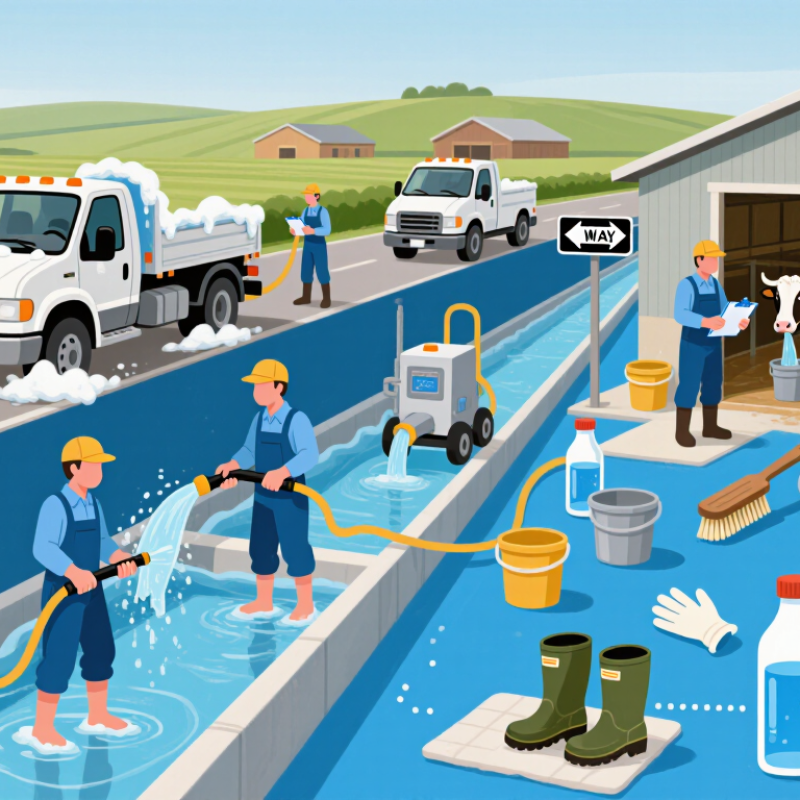
This guide examines how to ensure biosecurity with vehicle and footbath disinfectants across farms, livestock facilities, and transport routes. Dr. William A. Rutala, a leading disinfection researcher, states, “Cleaning must precede disinfection.” The principle is simple. Mud, manure, and organic matter can shield pathogens from disinfectants. A vehicle wheel arch may look clean from a distance, yet retain contamination in grooves and underguards. Footbaths can fail when solution levels drop, footwear remains dirty, or contact time is ignored.

WOAH guidance emphasizes risk-based biosecurity, controlled movement, and effective cleaning and disinfection procedures. Product selection must follow the manufacturer’s label, approved use, dilution, temperature, and required contact time. No chemical replaces disciplined routines. That is worth admitting. Even a strong disinfectant may perform poorly under rushed field conditions. Staff training, visible checklists, solution monitoring, and scheduled replacement create stronger barriers. This 2026 guide connects technical evidence with practical experience, while recognizing that every site has different traffic patterns, weather, surfaces, and disease risks. Good biosecurity is not perfect. It is consistently measured, reviewed, and improved.
2026 Top Guide How to Ensure Biosecurity with Disinfectants?

Define Biosecurity Risks Across People, Animals, Surfaces, and Water

2026 Top Guide: How to Ensure Biosecurity with Disinfectants

Biosecurity begins by mapping risks across people, animals, surfaces, and water. Staff may carry contamination on boots, gloves, hands, or vehicle pedals. Visitors need controlled entry, clear routes, and clean protective clothing. Animal movement also matters, especially near barns, pens, loading areas, and isolation rooms. A simple risk map often reveals overlooked contact points.

Surface disinfection requires cleaning before applying the disinfectant. Organic matter can reduce performance, leaving dangerous blind spots. High-touch areas include door handles, feed tools, rails, drains, and phone screens. Use the correct concentration, contact time, and application method stated on the product label. Keep treated surfaces visibly wet for the required period. Rushing this step is common, and it weakens protection.

Water needs separate attention. Storage tanks, pipes, troughs, and standing puddles can support repeated contamination. Test water quality regularly and inspect dead ends in plumbing systems. People should record dilution, temperature, contact time, and cleaning frequency. These records support reliable decisions and help identify failures. Still, no plan is perfect. A disinfectant may be suitable on a hard surface but unsuitable for skin, animals, or drinking water. Review the procedure after illness, equipment changes, or unusual animal behavior. Small errors deserve attention.

2026 Top Guide: How to Ensure Biosecurity with Disinfectants?

Define biosecurity risks across people, animals, surfaces, and water

The chart uses a practical 1–5 biosecurity priority index based on exposure frequency, pathogen transfer potential, and control difficulty. People and animals require strict movement, hygiene, and isolation controls; surfaces require cleaning before disinfection; and water requires continuous quality monitoring and validated treatment. Disinfectants should always be selected and applied according to the target organism, concentration, contact time, temperature, and organic load.

Reference framework: WHO water safety and infection prevention guidance, CDC environmental infection-control principles, and WOAH biosecurity recommendations. The index is a planning aid, not a measured epidemiological rate.

Choose EPA-Registered Disinfectants for the Target Pathogen

How to Ensure Biosecurity with Disinfectants in 2026

Biosecurity begins with matching the disinfectant to the target pathogen. An EPA-registered product is not automatically suitable for every organism. Check the current label for the exact pathogen claim, approved surface, dilution, and contact time.

The registration number supports product oversight, but the label defines legal and effective use. Do not guess.

Clean visible soil before disinfection. Organic matter can reduce performance, especially on floors, tools, drains, and animal housing surfaces.

Prepare the solution accurately with measured water and product. Keep the surface visibly wet for the full contact time. A quick spray and wipe may look efficient, but it may fail the label requirement. That weakens control.

Practical biosecurity also depends on people. Train workers to read labels, wear the listed protective equipment, and prevent cross-contamination between clean and dirty areas.

Store containers safely and keep them properly identified. Record the product, EPA registration number, dilution, application date, and responsible worker. Review these records regularly.

Even careful teams make errors. In one common oversight, staff check the pathogen claim but ignore water temperature or surface compatibility. That small gap deserves attention.

Verify label updates through official regulatory sources, and reassess the disinfectant when the target pathogen, facility conditions, or cleaning process changes.

Apply WHO’s 0.1% Chlorine Standard for Routine Surface Disinfection

Biosecurity begins with disciplined surface care, not with a stronger chemical.

For routine environmental disinfection, WHO guidance commonly uses 0.1% chlorine, equal to 1,000 ppm available chlorine. This concentration suits frequently touched, non-critical surfaces after visible soil has been removed.

Clean desks, door handles, rails, counters, and equipment with detergent and water first. Organic material can reduce chlorine’s effectiveness.

Prepare the solution according to the concentration printed on the container. Do not guess the dilution.

A trained worker should check the calculation, label the container, and record the preparation time. Apply enough solution to keep the surface visibly wet for the required contact time. Follow the product instructions and local infection-control procedure, because contact times can differ.

Wear suitable gloves and eye protection, and improve ventilation where possible. Never mix chlorine with acids, ammonia, or other cleaners.

Use a fresh solution as required by facility policy, especially when heat, sunlight, or heavy contamination may reduce its strength. Store chemicals securely and away from food, medicines, and children.

In practice, missed high-touch areas are often a bigger problem than inadequate effort.

A quick wipe may look clean but fail disinfection. Staff training should include a simple demonstration, such as marking a door handle with removable lotion and checking coverage afterward. Records help, although paperwork alone cannot prove good cleaning. Direct observation still matters.

Maintain Label Contact Time and Complete Surface Wetting

2026 Top Guide: How to Ensure Biosecurity with Disinfectants

Effective disinfection depends on more than choosing a strong chemical. The surface must remain visibly wet for the contact time printed on the product label. Wet means wet. If a counter dries after two minutes, but the label requires ten, the process is incomplete. Staff should use a timer rather than rely on memory or speed.

Remove organic matter before applying disinfectant. Dirt, manure, feed residue, and body fluids can reduce performance. Clean high-touch areas such as door handles, rails, equipment controls, and floor edges. Apply enough solution to cover every section, including seams and textured surfaces. A dry corner can become a hidden weakness.

During routine inspections, I have seen workers spray quickly and move on. That habit feels efficient, but it creates uneven coverage. Reapply disinfectant when drying occurs too early. Follow the label for dilution, temperature, ventilation, and required protective equipment. Never mix products unless the label specifically permits it. Record the time, area, solution concentration, and operator. These details support accountability and help identify repeated mistakes. Biosecurity improves when procedures match real working conditions, not ideal ones.

Validate Performance Against EN 13697’s 4-Log Bacterial Reduction Criterion

2026 Top Guide: How to Ensure Biosecurity with Disinfectants?

Validate Performance Against EN 13697’s 4-Log Bacterial Reduction Criterion

A 4-log reduction means a 99.99% decrease in viable bacteria under defined test conditions. EN 13697 evaluates disinfectant performance on non-porous surfaces. The method specifies organisms, contact time, temperature, and interfering substances. These details matter because a wet laboratory surface differs from a dry production bench.

ECDC’s 2022–2023 point prevalence survey estimated that 7.1% of hospital patients in the EU and EEA had at least one healthcare-associated infection. WHO also reports higher infection risks in resource-limited settings. These figures show why surface disinfection requires evidence, not assumptions. Ask for complete EN 13697 test documentation. Check the tested bacteria, soil load, exposure time, and required product concentration. Then compare those conditions with daily cleaning routines.

A strong result can still fail in practice. Missed corners, poor wiping, and early drying may reduce real protection. I have seen teams trust a short contact time without keeping surfaces visibly wet. That is an avoidable weakness. Record dilution, application volume, contact time, and operator training. Recheck performance when water quality, temperature, or surface materials change. The 4-log criterion is a useful control point, not a magic shield.

2026 Top Guide: How to Ensure Biosecurity with Disinfectants? Validate Performance Against EN 13697’s 4-Log Bacterial Reduction Criterion

Validation Dimension EN 13697-Based Requirement or Data Point Biosecurity Relevance Acceptance / Review Status
Applicable standard EN 13697:2015+A1:2019, quantitative non-porous surface test for chemical disinfectants and antiseptics used in food, industrial, domestic, and institutional areas. Provides a standardized way to assess surface disinfection performance under defined laboratory conditions. Required
Test surface A standardized non-porous surface is inoculated, treated with the disinfectant, and examined after the specified contact time. Represents hard, cleanable surfaces such as stainless steel, coated metal, glass, or other validated non-porous materials. Must match intended use
Bacterial efficacy criterion At least 4.00 log10 reduction in viable bacterial count under the declared test conditions. A 4-log reduction corresponds to reducing the recoverable bacterial population by a factor of 10,000, subject to the method’s controls and recovery limits. Pass: ≥ 4.00 log10
Log-reduction calculation Log reduction = log10(control count) − log10(treated count), using valid recovered counts. Makes performance measurable and comparable instead of relying only on qualitative claims such as “kills bacteria.” Calculation documented
Reference bacteria The test panel should follow the current standard and the intended claim. Common EN disinfectant test organisms include Staphylococcus aureus, Pseudomonas aeruginosa, and Enterococcus hirae; the applicable laboratory protocol determines the final panel. Challenges the disinfectant against both Gram-positive and Gram-negative bacteria relevant to hygiene validation. Verify claimed spectrum
Contact time The product must remain wet on the test surface for the complete declared contact time. A claim is valid only for the tested time and conditions. Insufficient wet contact time can cause a major difference between laboratory efficacy and real-world biosecurity performance. Record in minutes
Test temperature Temperature must be stated and controlled according to the selected EN 13697 test condition and the intended application. Disinfectant activity can vary with temperature; uncontrolled temperature reduces confidence in repeatability. Controlled and reported
Clean and dirty conditions Organic load conditions must be declared because test performance may differ between clean conditions and conditions containing interfering substances. Soil, protein, and other residues can reduce disinfectant availability and protect microorganisms. Use the condition matching application
Neutralization and recovery controls The laboratory must demonstrate that the disinfectant is effectively neutralized and that surviving organisms can be recovered without test-related bias. Prevents continued disinfectant action or poor recovery from creating misleading log-reduction results. Mandatory control evidence
Control validity Untreated or control surfaces must produce valid recoverable bacterial counts within the method’s specified suitability and reproducibility requirements. A large apparent reduction is not meaningful if the starting control count or recovery system is invalid. Confirm before interpreting results
Product concentration The exact use concentration, dilution method, preparation time, and product form must be recorded. A result at one concentration cannot automatically validate a weaker dilution or a different preparation method. Match label and test report
Surface preparation The surface should be visibly compatible with the test method and free from unintended residues that could interfere with disinfectant activity or microbial recovery. Pre-cleaning is essential when organic contamination or residues are present in operational areas. Include in SOP
Result interpretation A result of 4.00 log10 or higher supports the specified bactericidal claim only for the tested organisms, surface, concentration, temperature, soil condition, and contact time. Prevents overextending laboratory evidence to untested pathogens, surfaces, or operating conditions. Do not generalize beyond scope
Routine biosecurity verification Maintain batch records, dilution checks, contact-time observations, equipment calibration records, training records, and periodic review of the efficacy report. Confirms that validated laboratory performance is reproduced consistently during daily sanitation operations. Continuous monitoring
Core validation rule: Accept the bacterial surface-disinfection claim only when the complete EN 13697 test evidence demonstrates a valid reduction of at least 4.00 log10 under the declared concentration, contact time, temperature, organic-load condition, surface type, and reference-organism scope.

FAQS

How should a facility identify biosecurity risks?

Map risks around people, animals, surfaces, and water. Check boots, gloves, vehicle pedals, pens, drains, and loading areas. Small contact points matter. Review the map after illnesses, equipment changes, or unusual animal behavior.

Why must surfaces be cleaned before disinfection?

Soil, manure, and other organic matter can weaken disinfectant performance. Clean floors, tools, rails, drains, and handles first. A clean-looking surface may still contain contamination. Do not rush this step.

How can staff apply disinfectant correctly?

Use the stated concentration, application method, and contact time. Keep the surface visibly wet for the full required period. A quick spray may not work. Measure water and disinfectant carefully.

Which areas need frequent attention?

Focus on door handles, feed tools, rails, drains, phones, counters, and equipment controls. These points receive repeated hand contact. Check them during direct observation. Paperwork alone cannot prove good cleaning.

How should a facility select a disinfectant?

Match the product to the target pathogen and intended surface. Confirm the current label, approved use, dilution, and contact time. A registered product is not suitable for every situation. Do not guess.

What records support reliable disinfection?

Record the product, dilution, preparation time, temperature, contact time, date, and responsible worker. Keep containers clearly identified. Review records regularly. Records help, but mistakes can still hide between entries.

How should water systems be included in biosecurity planning?

Inspect tanks, pipes, troughs, dead ends, and standing puddles. Test water quality regularly. These areas may support repeated contamination. The plan is incomplete without water checks.

What precautions apply when using chlorine solutions?

Routine surface disinfection may use 0.1% available chlorine, when appropriate. Follow the container instructions and local procedures. Never mix chlorine with acids, ammonia, or other cleaners. Wear suitable gloves and eye protection.

How can workers improve cleaning consistency?

Train workers to separate clean and dirty routes. Demonstrate coverage by marking a door handle with removable lotion. Check whether the marked area was reached. People make errors, even with good training.

Conclusion

Biosecurity depends on identifying risks across people, animals, equipment, surfaces, and water before selecting a control strategy. Choose an EPA-registered disinfectant that is appropriate for the target pathogen and the intended use area, while following all label directions. For routine surface disinfection, a 0.1% chlorine solution may be used where suitable, with careful attention to material compatibility, ventilation, and safe handling. The goal is to reduce contamination without creating additional risks for workers, animals, or the environment.

Effective application requires complete surface wetting and strict adherence to the stated contact time; wiping too soon can greatly reduce performance. Facilities should also establish monitoring and validation procedures, including testing against EN 13697, which uses a 4-log bacterial reduction criterion as a useful benchmark. These principles explain how to ensure biosecurity with vehicle and footbath disinfectants, helping maintain consistent hygiene at entry points, transport routes, animal areas, and shared equipment.

Charlotte

Charlotte

Charlotte is a seasoned marketing professional with a deep understanding of the company's portfolio and a passion for elevating its presence in the market. With a keen eye for detail and a commitment to excellence, she ensures that our professional blog is regularly updated with insightful articles......